




Red light therapy devices use specific wavelengths of light to support biological processes in the body. These wavelengths typically fall within a therapeutic range of about 600 to 1070 nanometers (nm), which is a portion of the light spectrum where light can enter tissue and interact with cells effectively.
Within this range, two types of light are most commonly used:
-
600 nm to 660 nm (red light) is commonly used for surface-level goals like skin health and collagen support.
-
800 nm to 870 nm (near-infrared light) is often chosen for deeper tissues like muscles and joints.
Although near-infrared sits just beyond visible red on the light spectrum, red and near-infrared wavelengths are often grouped together in photobiomodulation research and both used in therapeutic devices because they produce similar biological effects.
Research shows that these ranges fall within a therapeutic “optical window” — wavelengths that can enter the body and interact with cells effectively. Within that window, depth becomes the key difference: shorter red wavelengths tend to affect more superficial tissue, while longer near-infrared wavelengths generally reach deeper layers.
What the research shows:
-
The therapeutic optical window for red light therapy (also known as photobiomodulation or PBM) spans roughly 600–1070 nm.
-
Red light (600–660 nm) is typically used for skin-level applications.
-
Near-infrared (800–870 nm) generally penetrates deeper into muscle and joint tissue.
-
Longer wavelengths tend to travel deeper — but penetration alone doesn’t guarantee results.
-
Different wavelengths may trigger slightly different biological responses, which is why device design matters.
-
Dose, timing, and consistency are just as important as wavelength.
If you’re choosing a device, look for clinically studied red (600–660 nm) and near-infrared (800–870 nm) ranges. Novaalab’s red light therapy devices are designed around these research-supported wavelengths for at-home use, whether your goal is skin support, muscle recovery, or joint comfort.
Red Light Therapy: Understanding the Wavelengths That Matter
If you’ve looked at red light devices, you’ve probably seen numbers like 630 nm, 660 nm, 810 nm, or 850 nm, often without much explanation. Those numbers refer to wavelength. A wavelength is simply the distance between peaks of a light wave, and it’s measured in nanometers (nm). And in red light therapy, different wavelengths determine:
-
What color the light appears to be
-
How deeply it can travel into tissue
-
Which biological responses are more likely to be emphasized
Most research and clinical applications consistently center around two ranges:
-
600 nm to 660 nm (red light): Most often used for skin and surface-level concerns
-
800 nm to 870 nm (near-infrared light): Commonly used for muscles, joints, and deeper tissues

The table below breaks down how commonly used wavelength ranges are typically positioned in research and device design.
| Red Light Therapy Wavelength Chart | ||||
|---|---|---|---|---|
| Wavelength Range | Light Type | Typical Depth | Common Uses | Why It’s Used |
| 600–630 nm | Red (Visible) | Surface skin layers | Skin tone support, elasticity, surface redness, cosmetic applications | Interacts strongly with surface tissues; often used in dermatology-focused devices |
| 630–660 nm | Red (Visible) | Skin + just below the surface | Collagen support, skin rejuvenation, wound healing | Frequently studied for supporting cellular energy in skin cells and fibroblasts |
| 800–830 nm | Near-Infrared (NIR) | Deeper soft tissue | Muscle recovery, joint comfort, tendon support | Commonly associated with mitochondrial energy support in deeper tissues |
| 850–870 nm | Near-Infrared (NIR) | Deep connective tissue and bones | Musculoskeletal recovery, circulation support, chronic pain | Often chosen when targeting deeper muscle groups and connective tissue |
| 900+ nm | Infrared | Variable; deeper potential | Specialized clinical applications; less common in at-home devices | May interact differently with tissue structures depending on dose and delivery |
When you look at these ranges together, a few patterns become clear:
-
Red light (600–660 nm) is most often positioned for skin-level goals.
-
Near-infrared (800–870 nm) is commonly used when deeper tissue support is the objective.
-
Infrared above 900 nm appears more often in specialized or clinical settings.
This is why many modern devices combine red and near-infrared wavelengths: Skin, muscle, and connective tissue sit at different depths, and a single number cannot address them all.
Therapeutic Light Wavelengths: Choosing the Best Wavelength for Light Therapy
When people search for the best wavelength for red light therapy, they’re usually deciding between two primary categories of therapeutic light: red light vs. near-infrared light (NIR).
However, red and near-infrared are not the only wavelengths used therapeutically. Other parts of the light spectrum — such as blue and yellow light — are also used in dermatology and clinical settings for specific surface-level goals.

Red Light (600–660 nm)
-
Visible to the eye
-
Tends to affect surface and shallow tissues
-
Common in skincare, dermatology, and cosmetic applications
Frequently used for:
-
Fine lines and skin texture support
-
Collagen production
-
Wound healing
-
Psoriasis and eczema support
-
Acne and redness management
-
Hair growth stimulation
Red light tends to interact more strongly with the upper layers of skin, which is why it’s often used for surface-level skin conditions and dermatology-focused devices.
Near-Infrared Light (800–870 nm)
-
Invisible to the eye
-
Travels deeper into soft tissue
-
Common in muscle recovery, joint support, and pain management devices
Frequently used for:
-
Arthritis and joint stiffness
-
Tendon and ligament support
-
Muscle pain and recovery
-
Chronic back or neck pain
-
Neuropathies and other nerve-related issues
-
Blood flow and tissue repair
Near-infrared wavelengths are often selected when targeting muscles, tendons, connective tissue, and joint structures beneath the surface.
Blue Light (400–500 nm)
-
Visible to the eye
-
Primarily affects the skin and oral surface
-
Common in dermatology and oral health treatments
Frequently used for:
-
Acne and acne-causing bacteria
-
Certain inflammatory skin conditions
-
Oil control and breakouts
-
Gum health and oral bacteria management
Blue light works differently from red and near-infrared light. Rather than focusing on tissue repair, it is commonly used to target bacteria on the skin or in the mouth, which is why it’s often used in LED face masks and oral care devices.
Yellow Light (570–590 nm)
-
Visible to the eye
-
Interacts primarily with the upper layers of skin
-
Common in cosmetic dermatology and skin-calming treatments
Frequently used for:
-
Redness and skin sensitivity
-
Uneven skin tone
-
Skin calming and brightness support
-
Reducing the appearance of fine lines and wrinkles
-
Supporting overall skin appearance
Yellow light is often used in cosmetic skincare settings because it may help support a calmer, more balanced complexion, particularly for redness-prone or sensitive skin.
The Practical Takeaway
-
If your goal is mainly skin-level treatment: Red light is typically emphasized, though yellow light can also provide added benefits.
-
If your goal involves muscles, joints, or deeper tissue support: Near-infrared (NIR) light is usually more relevant.
-
If your goal is targeting bacteria (such as acne or oral health concerns): Blue light is often used.
-
If you want versatility across multiple goals: Combination devices are your best option.
This distinction alone covers the majority of real-world device decisions. But depth is only part of the story. Once light reaches tissue, the body’s response depends on how cells absorb and use that energy — which is where wavelength differences become more biologically meaningful.
How Wavelength Shapes Your Body’s Response
Inside cells are mitochondria, often described as the cell’s “energy centers.” Many red and near-infrared wavelengths are studied because they can stimulate mitochondrial activity, helping cells produce ATP (adenosine triphosphate), the molecule that powers cellular function.
When cellular energy increases, research suggests this may support:
-
Tissue repair
-
Collagen production
-
Improvements in blood circulation
-
Modulation of inflammatory activity
-
Muscle recovery after strain or injury
Certain wavelengths — such as 630 nm to 660 nm and 810 nm to 850 nm — appear frequently in photobiomodulation (PBM) research. One reason is that these ranges align with absorption peaks in the PBM spectrum, where components inside mitochondria are especially responsive to light energy. This helps explain why those wavelengths are repeatedly used in clinical studies and therapeutic devices. Longer near-infrared and infrared wavelengths may influence tissue differently, potentially interacting with water-rich structures or ion channels depending on dose and delivery.
The key point: Wavelength doesn’t just affect how deep light travels, it may influence which biological pathways are emphasized.
Wavelength Is Important — But Power and Dose Matter Too
Wavelength determines how deeply light can travel and which biological pathways may be emphasized. But research consistently shows that outcomes depend on more than wavelength alone. This is why studies don’t just report wavelength, they also specify energy dose, treatment time, and session frequency.
One of the most important principles in photobiomodulation is the biphasic dose response. This means that light therapy does not follow a “more is better” pattern. At very low doses, light may have little to no effect. At optimal doses, beneficial biological responses are more likely. But at higher doses, those benefits may plateau or even decrease.
Because of this, effective treatment depends on delivering the right amount of energy and using it consistently over time.
Treatment results are influenced by:
-
Power density (irradiance, mW/cm², which is how much light is delivered at any moment)
-
Energy dose (J/cm², which is the total energy delivered over time)
-
Session length (how long the area is exposed)
-
Device design (beam spread, coverage, and consistency)
-
Frequency of use (one session vs. repeated treatments)
How to Choose the Right Wavelength and Device for Your Goals
The right choice depends on what you’re treating and what type of device you’re using.
If Your Focus Is Skin and Surface-Level Concerns
Look for devices emphasizing 600 nm to 660 nm (red light). This range is commonly used in:
-
Skincare and dermatology research
-
Collagen-support applications
-
Surface-level repair and tone
Because red light interacts more strongly with upper skin layers, it’s typically found in:
-
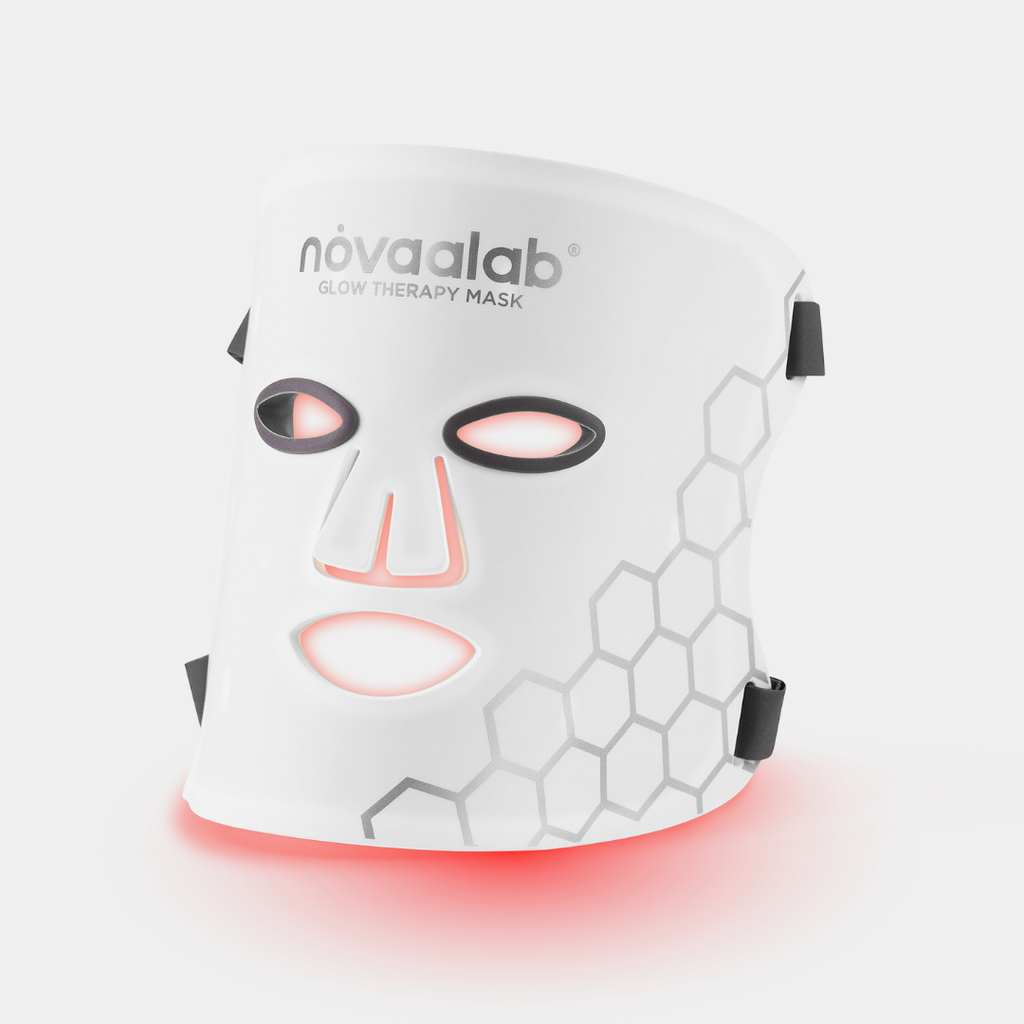
LED face masks, like the Novaa Glow Therapy Mask
-
Targeted skin devices like the Novaa Light Switch
-
Oral and gum-care light tools, like the Novaa Oral Care Pro
These devices are designed for surface tissues, where visible red light is most relevant.
If Your Focus Is Muscles, Joints, or Deeper Tissue
Look for devices that include 800 nm to 870 nm (near-infrared light). Near-infrared wavelengths travel deeper and are more commonly used for:
-
Muscle recovery
-
Joint comfort
-
Tendon and connective tissue support
-
Chronic musculoskeletal concerns
These wavelengths are typically emphasized in:
-
Flexible light pads and wraps, like the Novaa Light Pad and Deep Healing Pad XL
-
High-intensity handheld laser-style devices, like the Novaa Extra Strength Laser
-
Larger coverage panels and pods designed for full-body treatment, like the Novaa Recovery Pod
Because muscles and joints sit beneath layers of skin and fascia, deeper-penetrating NIR wavelengths are often preferred.
If You Want Broad Versatility
Many modern devices combine red (600–660 nm) and near-infrared (800–870 nm). This combination approach reflects how research is structured, pairing superficial and deeper wavelengths to address layered tissues in one session.
There’s also a biological reason for this pairing. Red and near-infrared light interact with cells slightly differently, particularly in the mitochondria where cellular energy (ATP) is produced. Some research suggests that using both ranges together may support energy production more effectively than using either one alone under certain conditions.
In simple terms: Red and near-infrared light may complement each other — not just in depth, but in how cells respond.
Choose a combination device:
-
The Novaa Light Pad and Novaa Recovery Pod uses both red and near-infrared wavelengths to support surface and deeper tissues across larger treatment areas. Pads and panel-style devices are ideal when coverage and convenience are priorities.
-
The Novaa Extra Strength Laser is a low-level laser therapy (LLLT) device — sometimes called a “cold laser.” Unlike LED light therapy pads that spread light broadly, LLLT devices use focused laser diodes to deliver more concentrated light energy to a specific point. This makes them well suited for joints, tendons, or localized areas that benefit from precision targeting.
-
The Novaa Light Switch takes a modular approach. It includes interchangeable heads designed for different applications:
-
A red + near-infrared LED head for general tissue support
-
A red + near-infrared laser head for more concentrated, targeted delivery
-
A skin-focused LED head (including red light, blue light, yellow light, and NIR light) for cosmetic and dermatology-oriented use
This design reflects an important principle: Different tissues and different goals may benefit from different wavelengths and delivery styles. If you want flexibility to both treat your skin and muscles plus aid your recovery, combination devices align closely with how photobiomodulation is studied in research. If precision and intensity in a small area are priorities, a targeted LLLT device may be more appropriate.
Choose Your Wavelength with Clarity and Confidence
Red light therapy isn’t about chasing a single number. It’s about understanding how different wavelengths interact with tissue, and choosing a device that aligns with your goal.
Research consistently supports red and near-infrared light within the 600 nm to 1070 nm “therapeutic window,” with clear patterns:
-
600 nm to 660 nm is commonly used for skin and surface-level concerns
-
800 nm to 870 nm is frequently used for muscles, joints, and deeper tissue
-
Combination devices offer broader, layered coverage
But the most effective approach isn’t finding a “perfect” wavelength, it’s choosing a thoughtfully designed device that pairs the right wavelengths with appropriate power and coverage for your needs.
That’s why Novaalab devices are built around research-backed red (600–660 nm) and near-infrared (800–870 nm) ranges, offering options for skin-focused applications, deeper musculoskeletal support, and full-body versatility. Whether you’re targeting skin health, muscle recovery, joint comfort, or overall wellness, Novaalab’s red light therapy devices are designed to help you match wavelength to purpose — safely, effectively, and confidently at home.


Leave a comment